
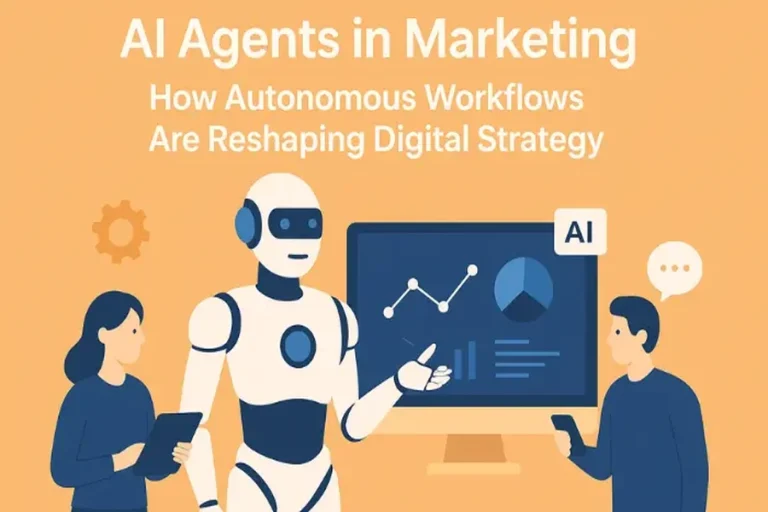
Marketing agencies have always been built on one core challenge: managing a lot of moving parts at the same time.
There are clients to communicate with, campaigns to plan, content to produce, approvals to chase, and performance reports to deliver. Even a small agency can end up juggling dozens of tasks across multiple brands in a single week. Multiply that by several clients, and things can get complicated fast.
For a long time, agencies handled this complexity by adding more tools and more people. One platform for social scheduling, another for email marketing, another for design, another for analytics. It worked, but it also created fragmentation. Teams spent as much time switching between systems as they did actually doing the work.
That is where AI has started to change the structure of agency workflows in a meaningful way.
Not by replacing people, but by reducing the friction between tasks.
Agencies are shifting from tool stacks to unified systems
Traditionally, a marketing agency’s workflow looks something like this:
A strategist plans a campaign in one tool. A copywriter creates content in another. A designer builds visuals somewhere else. A social media manager schedules posts in a separate platform. Then someone manually compiles reports at the end of the month.
Each step works, but the handoffs between them create delays and inconsistencies.
Modern AI-powered platforms are starting to reduce those gaps. Instead of treating each task as a separate process, they bring planning, creation, editing, scheduling, and reporting into a more connected flow.
This shift is not just about convenience. It changes how agencies operate at a structural level. Work becomes less segmented and more continuous.
When content creation, approval Digital Marketing Agency, and publishing happen in the same environment, teams spend less time exporting, reformatting, and re-uploading assets. That alone can save hours every week.
AI is becoming a production assistant, not just a writing tool
Early AI tools in marketing were mostly focused on writing assistance. They helped generate captions, headlines, or blog drafts. Useful, but limited.
What has changed in recent years is how agencies are now using AI across the entire production process.
Instead of just writing content, AI is being used to:
- Turn strategy notes into structured campaign plans
- Generate variations of ad copy for testing
- Repurpose long-form content into multiple formats
- Adapt messaging for different platforms automatically
- Suggest improvements based on past performance data
This means AI is no longer sitting at the beginning of the workflow. It is embedded throughout it.
For agencies, this reduces repetitive work. A single idea can be expanded into a full campaign much faster than before. More importantly, it allows teams to focus on direction, strategy, and client communication instead of manual execution.
Client management is becoming more organized and transparent
One of the most time-consuming parts of agency work is client communication.
Feedback loops, revision requests, approvals, and updates often happen across email threads, chat apps, and spreadsheets. Information gets scattered, and tracking decisions becomes difficult.
AI-powered systems are starting to bring more structure to this process.
Instead of sending files back and forth, clients can review content directly inside a shared workspace. Comments, approvals, and revisions are attached to specific pieces of content, which reduces confusion.
Some platforms even use AI to summarize feedback or highlight what needs attention, which makes it easier for teams to respond quickly.
This improves transparency on both sides. Clients have a clearer view of what is happening, and agencies spend less time interpreting scattered feedback.
Content creation is being standardized without losing flexibility
One of the biggest concerns agencies had when AI first entered the space was whether it would make content feel generic.
That concern still exists, but the way agencies are using AI today is more controlled.
Instead of relying on AI to generate everything from scratch, many teams now use it within defined frameworks. They establish tone guidelines, messaging principles, and brand direction first. Then AI is used to produce content that fits within those boundaries.
This is where brand consistency becomes easier to manage at scale.
A single campaign can produce dozens of variations while still sounding cohesive. Social posts, email sequences, blog content, and ad copy can all follow the same voice without requiring manual rewriting each time.
This approach helps agencies maintain quality while increasing output, which is often one of the hardest balancing acts in client work.
Reporting and optimization are becoming more data-driven
Reporting has traditionally been one of the most manual parts of agency operations.
Teams would gather data from multiple platforms, build spreadsheets, and then try to translate numbers into insights for clients. It is important work, but time-consuming and often repetitive.
AI is now being used to simplify this process.
Instead of manually compiling reports, systems can pull performance data automatically and present it in structured summaries. Some tools even highlight trends, such as which content types are performing best or which campaigns are underperforming.
This allows agencies to spend less time formatting data and more time interpreting it.
The shift is subtle but important. Reporting becomes less about documentation and more about decision-making.
Collaboration is becoming more centralized
In many agencies, collaboration used to happen across too many disconnected tools. Designers worked in one environment, writers in another, strategists in documents, and account managers in messaging apps.
Modern AI-supported platforms are trying to centralize this workflow.
When everyone works in the same system, there is less confusion about versions, approvals, and responsibilities. Tasks are clearer, timelines are easier to track, and accountability improves naturally.
In many cases, agencies describe this as moving toward an “all in one agency” model, where planning, production, and delivery are no longer split across multiple disconnected tools.
It is not just about efficiency. It is about reducing the cognitive load of managing complex workflows across teams.
Agencies are focusing more on strategy and less on manual execution
Perhaps the most important shift is not technical, but behavioral.
As AI handles more of the repetitive execution work, agencies are gradually shifting their focus toward higher-level strategy.
Instead of spending hours writing variations of the same content, teams can focus on:
- Understanding client goals more deeply
- Planning better campaigns
- Improving messaging strategy
- Analyzing performance patterns
- Strengthening brand positioning
This does not mean execution is disappearing. It just means it is becoming more automated and less time-intensive.
In many ways, AI is pushing agencies to return to what they were originally meant to do, which is think strategically and solve marketing problems rather than manually produce every asset.
The real change is workflow, not just technology
It is easy to think of AI in marketing as just another tool in a long list of software options. But what is happening inside agencies suggests something more structural.
Work is becoming more connected, more automated, and more centralized. Tasks that used to be separate are now part of continuous systems. Teams are collaborating in shared environments instead of fragmented platforms. And AI is quietly supporting most stages of production without taking over the creative direction.
The agencies adapting fastest are not necessarily the ones using the most tools. They are the ones redesigning how their workflows actually function.
And that shift is what is defining the next era of marketing operations.