
Introduction
Agile teams aim to speed up delivery without any compromise in quality. Every choice they make affects the quality of the product. So this type of fast-paced work environment, the product owner (PO) plays an essential role in connecting the business objectives with team performance. They act as the link that makes sure every feature adds benefit to the stakeholders and customers.
Product Owners are at the center of any Agile initiative, influencing the way teams decide about, plan, and execute. The way in which a PO is a leader directly influences the products that are constructed and how well Agile teams produce results. As more and more companies adopt Agile at a larger scale, understanding this aspect is now vital, not just for those who practice, but also for everyone involved in shaping digital products.
In the article below, we are going to dive deep into the role of the product owner in the agile scrum methodologies.
Understanding Product Ownership in Agile Scrum
| Product ownership is the strategic and tactical function that ensures a product develops in the right direction. |
In comparison with traditional project roles, Product Ownership is
- Iterative,
- Collaborative, and
- Customer-centric.
The PO manages and optimizes the product backlog to maximize product value and guide development teams effectively.
Who Is the Product Owner?
| The Product Owner is one of three critical roles in Agile Scrum methodology, alongside the Scrum Master and the Development Team. |
A Product Owner is the decision-maker who represents customer needs, business goals, and stakeholder expectations.
They define:
- User stories,
- Prioritize features, and
- Set the direction for every Sprint.
The PO is considered the “heart of an Agile team” who ensures the product remains customer-focused and transparent throughout development.
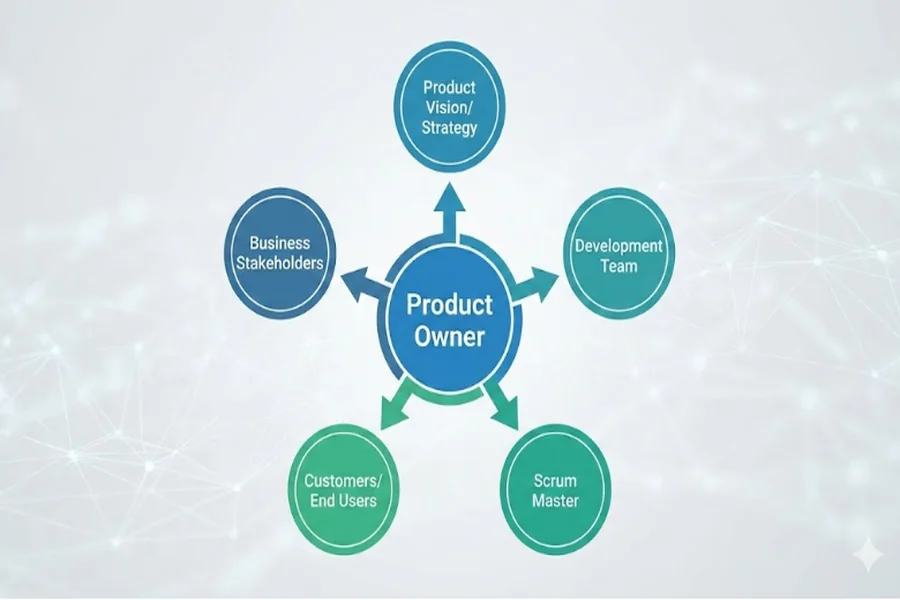
The Place of the Product Owner Within an Agile Ecosystem
The PO sits at the intersection of business, technology, and user needs. In the Agile ecosystem, they balance strategic decision-making with hands-on collaboration.
The POs shape:
- Architectural decisions,
- Communicate stakeholder needs, and
- Influence cross-functional teamwork at all levels, from organizational to individual.
What are the roles and responsibilities of the Product Owner in Agile Scrum Methodology?
The responsibilities of a Product Owner are not limited to managing the product backlog.
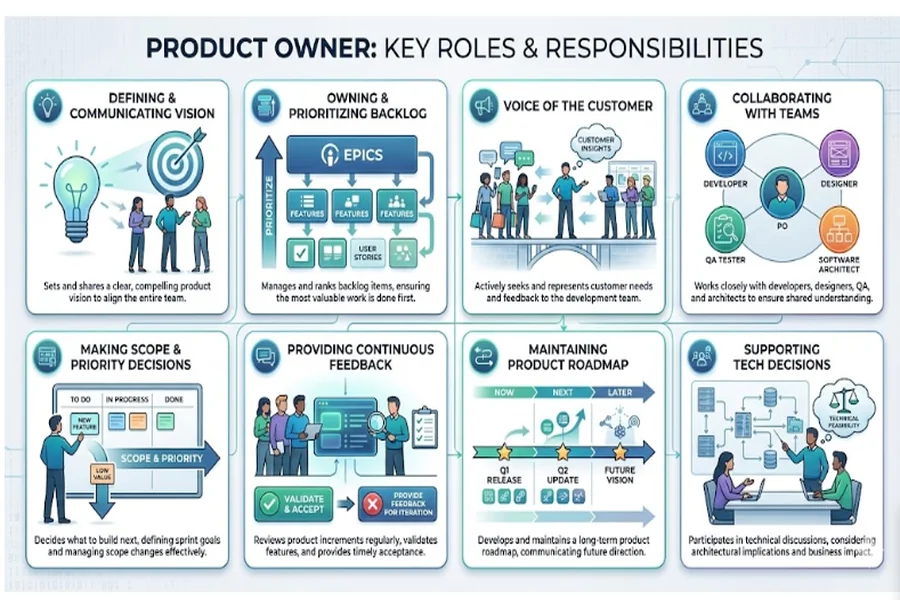
Here, the following core responsibilities are listed for your clear understanding.
He acts as:
1. Visionary & Strategist:
POs create a clear product vision based on customer needs, business goals, and market research. They ensure the team understands this vision, enabling consistent, value-driven development.
Backlog Architect:
This is the PO’s core responsibility. They gather, refine, prioritize, and continuously update the backlog to reflect evolving customer needs and organizational priorities.
2. Value Enhancer:
The PO’s core duty is to maximise the value delivered by the Scrum Team. They do this by rigorously prioritising backlog items based on their perceived value, risk, and necessity, always asking,
“What brings the most benefit to our users and our business right now?”
3. The Voice of the Customers:
The PO is the primary channel through which customer requirements and expectations reach the team. This includes translating business needs into technical language that the team can implement.
4. Decision Maker:
They decide what goes into each Sprint or release based on customer value and business strategy. Their decisions directly influence ROI and time-to-market.
5. Communicator & Collaborator:
POs work with developers, designers, QA teams, architects, and leaders. They answer questions, clarify requirements, and ensure that every Sprint produces high-value outcomes.
6. Stakeholder Manager:
They act as the single point of contact for all stakeholders, managing expectations, gathering feedback, and ensuring their needs are understood and balanced.
7. Product Roadmap Maintainer:
They oversee long-term direction and ensure the roadmap adapts to changing market conditions.
8. Reviewer & Adaptor:
POs attend reviews, validate deliverables, ensure adherence to the Definition of Done, and guide teams toward improvement.
The Importance of a Dedicated Product Owner
| Without a dedicated, empowered Product Owner, Scrum teams can lose direction. |
This role ensures maximum value addition from products developed by the Agile Scrum team. The Product Owner’s deep understanding of both customer needs and market dynamics enables them to anticipate changes and new requirements, and to understand customer requirements from a journey lifecycle perspective.
| A strong PO provides clarity, focus, and direction. |
That means, A dedicated PO ensures:
- Faster decisions
- Clearer requirements
- Stronger stakeholder alignment
- Higher product value
- Better risk and change management
What improves your skills as a Product Owner?
Understanding the role of the Product Owner in Agile is made much easier by the career-enhancing CSPO certificate training. This training helps professionals to master prioritization, product visioning, and decision-making based on customer needs. Also increases confidence in the real world and improves the collaboration between Scrum team members, and helps with the delivery of high-quality products regularly.
The Key Moments a Product Owner Shapes the Scrum Process
The PO’s influence is most visible at specific Scrum events:
- Sprint Planning: In this event, they define priorities, clarify user stories, and ensure the team understands customer expectations.
- During the Sprint (Daily Support): They answer questions and provide clarifications needed to maintain momentum and quality
- Sprint Review: They validate completed work, gather feedback, and align with stakeholders for future changes.
- Backlog Refinement: They refine items, ensure clarity, and adjust priorities based on feedback, data, and evolving needs.
- Roadmap Adjustments: They continuously evaluate long-term direction, making strategic updates when markets shift or user trends evolve.
Conclusion:
The Product Owner is central to Agile success. Their ability to connect customers, business strategy, and the development team ensures products deliver genuine value.
Organizations seeking to move to Agile-based product development methodologies must invest in skilled Product Owners who possess excellent communication skills, domain expertise, leadership capabilities, and the ability to make tough decisions.
With the right Product Owner, Agile teams can easily navigate complexity, respond to change effectively, and consistently deliver products that delight customers and achieve business objectives.