
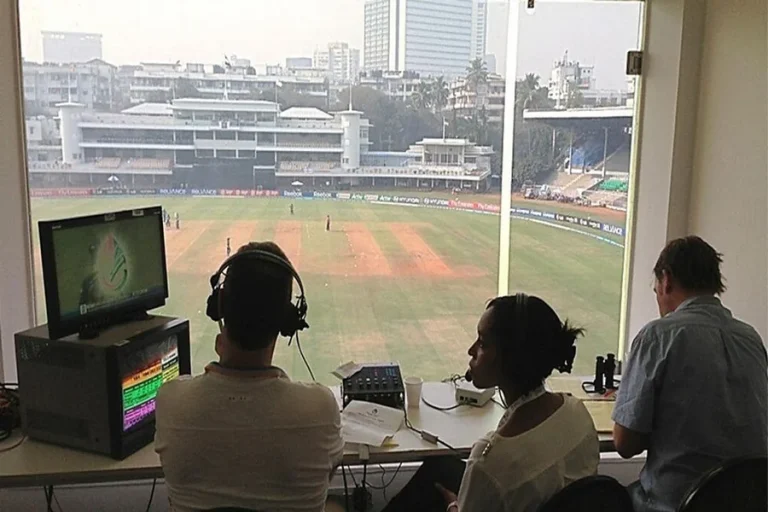
For many language learners, progress feels more natural when tied to an existing interest. One individual finds cricket commentary to be an effective listening workout for this very reason. The pace is authentic, mirroring real-time conversation. It employs common transitional words like “still,” “but,” and “so,” and repeats key patterns in a way that helps the brain absorb them organically, without rote memorization. The emotional peaks in the commentary also make certain phrases more memorable.
The Value of Sports Commentary for Language Development
Commentary occupies a unique space between casual talk and formal speech. Top commentators articulate their thoughts clearly yet conversationally. They outline strategies, react to unfolding events, and narrate outcomes. The ability to follow this narrative flow builds confidence that translates to other contexts, like understanding English in business meetings, podcasts, or daily conversations.
The approach isn’t to treat a match as a formal lesson, but as consistent exposure. The listener simply absorbs, notices patterns, and later practices small, manageable chunks of language. This keeps the practice sustainable and low-pressure. Missing a detail isn’t a cause for alarm; the next delivery naturally resets the focus.
To add structure, simple, focused techniques are used:
- A Single Focus: Sessions might concentrate solely on transition words or pronunciation.
- Replay an Over: If a phrase is missed, replaying a single over helps catch it.
- Note Two Phrases: Keeping a short list of useful phrases for later personal use.
- Shadow a Sentence: Repeating a short line aloud to practice intonation and rhythm.
On less energetic days, the difficulty is adjusted. Switching to match highlights, slowing playback, or prioritizing clarity over complexity maintains momentum. The goal is building a durable habit, not achieving fluency in one sitting.
Integrating Audio with Visual Context
Platforms like DesiPlay are favored for providing live match visuals alongside commentary, creating a direct link between words and action. With the scorecard visible at desi live, the commentary becomes the primary practice tool. When a commentator mentions a field change, a glance at the screen confirms it. Discussing dot balls, building pressure? A check of the overall summary provides context. This interplay makes vocabulary concrete.
Due to the repetitiveness of cricket, such as a batter defending, a bowler delivering a slower ball, and a captain adjusting the field, the same sentence structures are repeated very often to the listeners. From one match to another, phrases that were hardly audible get clearer so that understanding can be done straight away without the need of an internal translation.
One practical technique is prediction: muting the stream for ten seconds, watching the play, and guessing what the commentator might say before unmuting to check. This engaging “mini-test” is used sparingly, perhaps one at a time.
Attention is also paid to three categories of phrases common in both sports and everyday English:
- Cause and Effect: “That’s why,” “as a result.”
- Probability: “You’d expect,” “it looks like.”
- Contrast: “Even so,” “on the other hand.”
The very first step to learning these expressions is seeing them in a context; consequently, when you later make an effort to use them, that is what really changes your passive listening into a skill that you can use.
Maintaining Enjoyment Over Pressure
To prevent practice from becoming stressful, the objective is kept simple: comprehension over perfection. Understanding the gist of an hour is usually seen as a positive point; missing a metaphor or two doesn’t matter. Also, it is important to pick the right moments; a noisy, crazy game hardly helps to learn, whereas a game with a more stable rhythm does.
As cricket has become a habit, it seems natural to combine English practice with it. Having a live page open with commentary in the ears provides natural, consistent exposure. These small, regular sessions accumulate over time. Listening confidence grows organically, and the enjoyment of the match remains intact.
Summary
DesiPlay supports this by offering a stable visual reference. A quick score check satisfies curiosity, allowing focus to return swiftly to the audio. This balance keeps the practice effective and the experience of the game itself genuinely enjoyable.
It is a method that, besides being a technical one, helps to establish a real cultural connection. The phrases, the local accents, and the impromptu reactions of the commentator are a kind of living photograph of English, which is a language used in a fervent, real-world context. It is not only about figuring out the words; it is about getting the gist, the humor, and the shared story that the language is transporting.
When one picks up a language through cricket, one gets the language with the same vitality of the game, and thus the whole process of learning gets transformed into being part of a world talk rather than an apparent study. It is this emotional involvement that really stays the learner with the language.


