
If you’ve spent any time researching alternatives to traditional public or private school, you’ve probably run into the word “microschool” more than once. It’s one of the fastest growing terms in education right now, and for good reason. Current estimates suggest anywhere from 750,000 to over 2 million students in the United States are now attending some form of microschool, and a recent parent survey found that roughly one in ten school families already has a child enrolled in one.
Despite the growth, a lot of parents still aren’t entirely sure what a microschool actually is, or how it’s different from homeschooling, a learning pod, or a small private school. Here’s a straightforward breakdown.
The Basic Definition
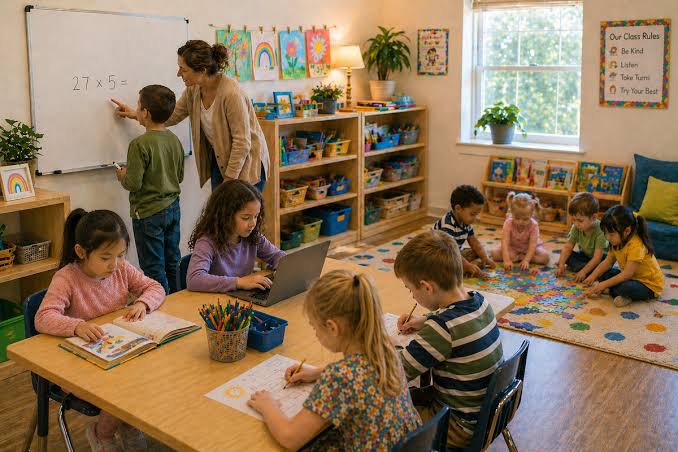
At its core, a microschool is a small, intentionally designed learning environment that serves students from multiple families, typically somewhere between 5 and 25 students, though most fall closer to the 8 to 15 range. The National Microschooling Center describes them as small, multifamily learning environments built around the specific educational needs of the students they serve, rather than a standardized curriculum designed for a much larger, more general student body.
The easiest way to picture it is as a modern version of the one-room schoolhouse. Students of different ages often learn together in the same space, working on personalized projects and moving at their own pace rather than sitting through a single lesson delivered to thirty kids at once. Student-to-teacher ratios in most microschools run somewhere between 8:1 and 10:1, which is dramatically lower than what you’d typically find in a traditional public school classroom.
How Microschools Actually Work Day to Day
Microschools vary quite a bit from one to the next, but a few characteristics show up consistently:
- Multi-age classrooms. Rather than grouping strictly by grade level, students of different ages frequently learn together, similar to how families in a homeschool co-op might combine kids of varying ages for shared lessons.
- Personalized, project-based learning. Instead of a single curriculum delivered the same way to every student, many microschools build lessons around each child’s interests and pace, with teachers acting more like guides or facilitators than lecturers standing at the front of a room.
- Flexible schedules. Some microschools operate a full school week, while others meet for as little as 10 to 20 hours a week, with families handling the remaining time independently.
- Small, often nontraditional spaces. A microschool might operate out of a dedicated building, but it’s just as likely to be running out of an office space, a community center, or even someone’s home.
- A specific educational philosophy or theme. Many, though not all, microschools are built around a particular approach, such as Montessori education, classical education, nature-based learning, or programs designed specifically for students with learning differences.
Microschool vs. Homeschooling vs. Private School
Because microschools borrow elements from several different educational models, it’s easy to confuse them with something else entirely.
Microschools vs. homeschooling. A traditional homeschool setup usually involves one family teaching their own children, sometimes joining a co-op for shared classes or activities. A microschool, by contrast, is a more structured, ongoing arrangement where multiple families send their children to the same dedicated space on a regular basis, with a consistent teacher or set of teachers running the program full time.
Microschools vs. private school. Private schools, even small ones, generally operate with a more traditional structure: defined grade levels, a set curriculum, formal accreditation, and a larger overall student body. Microschools tend to be smaller, more flexible, and more likely to blend age groups and personalize the curriculum on a per-student basis. Some microschools pursue accreditation and formal school status, while others operate more like a hybrid between a private school and a homeschool arrangement.
Microschools vs. learning pods. Learning pods, which became especially popular during remote schooling, are usually more informal and temporary, often organized by a handful of parents to share a tutor or teacher for a limited period. Microschools tend to be more established, ongoing programs, though the lines between a long-running pod and a small microschool can blur.
Why the Microschool Movement Has Grown So Quickly
A few forces have combined to fuel the rapid growth of microschools over the past several years. Public school enrollment has declined by more than a million students since 2020, and a portion of those families have gone looking for smaller, more personalized alternatives. Parent dissatisfaction with large class sizes and one-size-fits-all curriculum has pushed some families toward smaller settings where a teacher can actually get to know each child individually. At the same time, a number of states have expanded school choice funding, including education savings accounts, that families can put toward microschool tuition, which has made the option financially realistic for a wider range of households.
Educators have driven a lot of the supply side of this growth too. Many teachers who started microschools, such as Embrace Academy in Las Vegas, describe feeling burned out trying to meet the needs of 25 or 30 different students inside a single traditional classroom, and they found that a smaller, more intentional environment let them actually teach the way they always wanted to.
Things Worth Knowing Before Choosing One
Microschools offer real advantages, but they aren’t a perfect fit for every family, and it’s worth going in with realistic expectations. A few things to keep in mind:
- The regulatory landscape is still fairly new and inconsistent. There’s no single national definition or oversight standard for microschools in the United States, and requirements vary significantly by state.
- Accreditation and long-term academic outcomes are still being studied. Because the model has grown so quickly, there isn’t yet the same depth of long-term research on academic outcomes that exists for traditional schooling.
- Not every microschool is equally rigorous. Since the term covers everything from highly structured, accredited programs to loosely organized homeschool co-ops that have simply rebranded, it’s important to ask specific questions about curriculum, teacher qualifications, and daily structure rather than assuming all microschools operate the same way.
Is a Microschool Right for Your Family?
Microschools tend to appeal most to families who want smaller class sizes, more personalized attention, and more flexibility than a traditional public or private school offers, without going all the way to a fully independent homeschool setup. They can be an especially good fit for kids who thrive in smaller, more individualized settings or who haven’t done well in a large, standardized classroom environment.
As with any schooling decision, the right move is to visit in person, ask specific questions about curriculum and structure, and talk to current families before enrolling. The microschool model covers a wide range of approaches, and the right one for your child depends far more on the specific program than on the label itself.