
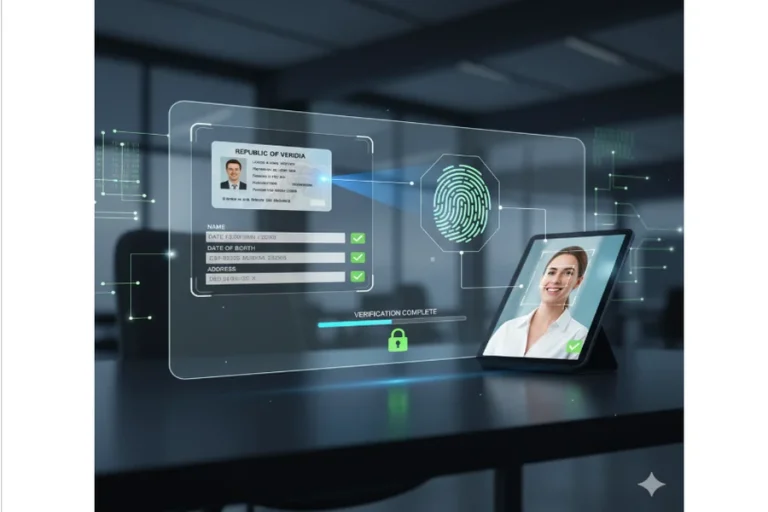
In the current fast moving digitalized world, companies are required to check the identity of their customers within a short time frame and in the most effective manner to avoid fraud and to fulfill their regulatory mandate. Automated document verification has become an essential product that has to be adopted by organizations intending to automate their Know Your Customer (KYC) and yet remain secure. With the rate of online onboarding ever-growing, firms are turning to state-of-the-art document verification solutions to verify identity documents as well as identify possible risks instantly. By changing manual reviews to automation, businesses are not only able to increase efficiency, customer experience, and lower operational costs.
The Demand of Effective KYC Document Verification
The usual KYC practices are an attempt to check passports, IDs, drivers licenses, and other documentation manually. Hand process is not only slow, but its possibility of error by a human being is more, which enhances the possibility of fraud documents being undetected. Automated KYC document verification solves such problems by applying AI-based algorithms, optical character recognition (OCR), and machine learning to process and verify documents in seconds. This technology ensures that there is great accuracy as well as less pressure on compliance teams.
As the number of global fraud cases grows and regulations become more complicated, the verification of financial services, fintech, eCommerce, gig platform, and telecommunications businesses can no longer be dependent on the human factor. Online identity document verification eliminates the possibility of identity theft as it confirms the validity of information and outlines the attempts at its falsification or alteration. This renders it a necessity to those companies that would like to have secure digital operations.
The Process of Automated Document Verification
Intelligent tools are used by the service providers of the Automated document verification services to capture, read, and evaluate documents provided by users during the onboarding process. It usually starts with the consumer posting a photograph or scanned image of his or her identification paper. The system will then process the data and identify any data with OCR technology and match the data with templates of authentic documents of different countries and jurisdictions.
Security checks like holograms, microprints, fonts, barcodes, and MRZ codes are examined through advanced document check systems to check if it is authentic. In case the document has passed all the validation tests, the system verifies the user; otherwise, it indicates that the document is to be checked by hand. This is a highly automated method of operation that saves a lot of time and at the same time provides more accuracy over the conventional ways of doing things.
Document Checker Job Description in Fraud Prevention
A contemporary document checker is very essential in averting fraud. The systems can detect forged or manipulated documents with high precision with advanced detection systems. This involves the identification of discrepancies in the data fields, identification of edited photos as well as irregular patterns suggesting the alteration. Through automation of verification, businesses are able to reduce risks of identity frauds, account takeovers, money laundering and synthetic identities.
Automated checks of the documents also are more scalable and companies can handle thousands of verification requests at the same time without experiencing any performance lapse. This is particularly useful when the platform is growing fast or receiving large volumes of onboarded.
Advantages of Automated Document Checking to Businesses
Automated document verification software provide a large number of benefits that can assist business to work much better and safer. Speed is one of the most important advantages. Immediacy Documents are automatically checked in real time and this allows faster customer onboarding and minimized the drop-off rates caused by delays. This will enhance customer experience and general satisfaction.
The other significant benefit is better accuracy. Given that automated systems are based on predetermined templates and algorithms they provide the same verification results as opposed to human reviews which have inconsistencies. Also, automated verification is less expensive, which minimizes the involvement of large amounts of manual processing and compliance departments.
Automated tools also simplify the process of compliance management because automated systems assist organizations in adhering to the standards of the world in terms of KYC, AML, and regulatory issues. Identity document verification through automation guarantees that businesses receive and verify the information of users as per the legal provisions and have transparency and audit trails.
Improved Security by the Use of New Technology
Any organization that has to deal with sensitive identity information is security conscious. The automated document check solutions are powered by sophisticated technologies such as artificial intelligence, machine learning, biometric matching, and data extraction to further increase the levels of security in the process of verification. Such systems are capable of identifying patterns, anomalies and risks that cannot be easily detected by the human reviewers.
Also, face matching and liveness detection (which are biometric features) can be combined with document verification to enhance identity assurance. The businesses can match the selfie of the user and the image on the document to ascertain that the individual filing the document is the owner.
The Reason Why Automated KYC Document Verification Is Important Nowadays
Increased adoption of digital is seen to push customers to a speedier and more secure onboarding interaction. Intelligent KYC verification of documents is designed to assist businesses to achieve these expectations and remain compliant and avoid fraud. In the fields of finance, healthcare, travel, online marketplaces and education, efficient identity verification is crucial in ensuring protection of platforms and creating trust among the users.
Automated solutions enable companies to invest in the future of their operations and respond to any type of security threats. Organizations can check identities more accurately, minimize regulatory risks, and optimize work overall with the help of automation, AI, and advanced analytics.
Conclusion
Automatized document validation has now become an essential part of the contemporary KYC. The intelligent document verification software can assist business in ensuring secure, fast and accurate verification of identity and reducing the risk of fraud and global compliance is assured. With ongoing gains in digital services, a trusted document verification can be the service that organizations ought to adopt so as to safeguard their platforms, simplify the onboarding process, and provide a smooth customer experience. The future of identity verification is automation and companies implementing such technologies today will stay competitive, compliant and secure in the future.