
HYBRIT’s Leap From Pilot Plant to Commercial Orders
The HYBRIT partnership, backed by mining company LKAB and utility Vattenfall alongside SSAB, spent nearly a decade proving that hydrogen-based reduction replaces coking coal in steelmaking. That proof stage is over. SSAB now runs commercial-scale volumes of fossil-free steel through its production lines, and the output goes into signed purchase orders rather than test shipments to a handful of showcase customers. The timing lines up with two forces at once: stricter carbon accounting in construction tenders across the Nordics, and production volume finally reaching a scale where distributors list the material as a standard product line rather than a special request. A material only becomes commercially real once a distributor can put a delivery date on it, not just a research date.
What It Means for Everyday Buyers
Traditional steelmaking runs iron ore through a blast furnace fed by coking coal, releasing roughly a tonne and a half of CO2 for every tonne of steel produced. Fossil-free steel swaps that coal-based reduction for hydrogen produced with fossil-free electricity, cutting emissions from the production step to a fraction of the conventional figure. The common assumption is that this cleaner grade needs special certification or different handling on site. In practice it carries the same EN 10025 mechanical certificates as any other structural steel and welds with the same parameters. The only difference on the mill certificate is one added line: the carbon footprint per tonne.
For a private buyer renovating a house or building a garage, this rarely changes what the steel looks like or costs to install. It changes the carbon line in the project’s material declaration, and that line increasingly decides building permits and mortgage-linked green renovation schemes, because carbon scoring has spread from large infrastructure tenders down to standard residential projects.
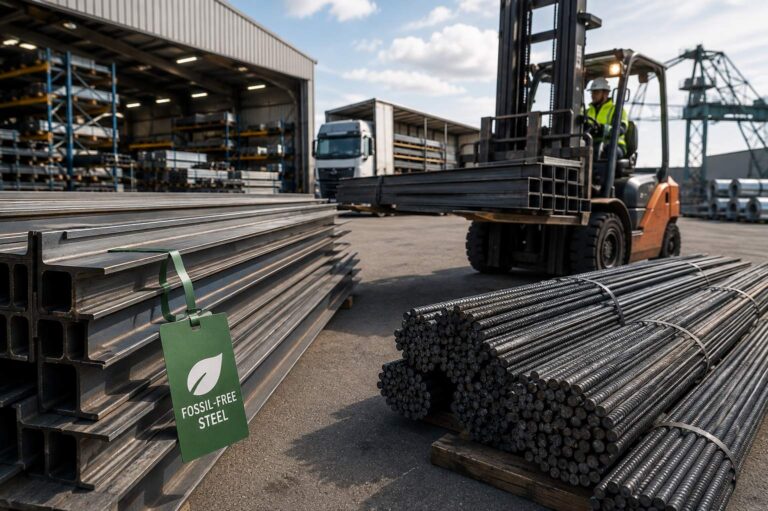
Reinforcement bar and structural beams, the everyday materials that make up most of a project’s steel volume, are precisely the categories where fossil-free grades are starting to appear as standard stock rather than premium specials, according to https://bygges.dk/u-staal-armering-og-bjaelker-kend-dit-staal/. These two product groups account for most of the tonnes ordered on an ordinary renovation or garage build, not the landmark towers usually pictured in headlines about the material.
Tibnor Bridges Nordic Producers and Baltic Demand
Tibnor distributes steel and metals from SSAB and other producers to roughly 10,000 customers across the Nordic and Baltic region, exactly the kind of network fossil-free steel needs to move beyond Sweden. A mill produces clean steel all day, but it only reaches a construction site in Riga or Vilnius if a distributor keeps it in stock and delivers it on a normal industrial schedule, cutting it to length along the way.
One detail buyers rarely see quoted: fabricators switching to a new steel batch, fossil-free or not, sometimes need to requalify their welding procedure specification before the first delivery lands on site. The mechanical properties match standard grades, but a cautious quality department still wants the paperwork updated, adding a week to an order that otherwise moves on a normal lead time.
Locally, Tibnor Latvia handles sales and warehousing for the construction and energy sectors, then delivers to site on request, which is where an order stops being a Swedish headline and becomes a delivery slip. Tibnor.lt lists current stock and product ranges, useful for buyers checking what is actually available today rather than on some future roadmap.
Is Green Steel Really Too Expensive for Consumers?
The assumption that hydrogen-based steel is reserved for flagship industrial projects doesn’t hold up once ordinary products enter the picture. As the reinforcement bar and beam figures above show, the everyday categories are moving first, not last. The idea that green steel is strictly a premium product lags behind what mills are actually shipping.
A price gap still exists, and it hasn’t closed for every product category. It narrows with each new contract rather than each new press release, now that production runs on live purchase orders instead of subsidized pilot volumes. For construction buyers in the Baltics, sourcing the material is a decision to make on a current project, not a plan to revisit in ten years.