
“Life is what happens to you while you’re busy making other plans.” — John Lennon.
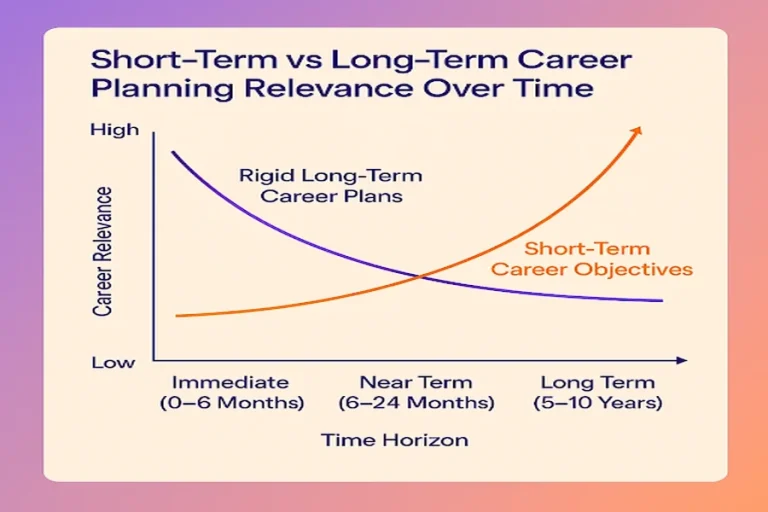
For decades, we were taught to believe that a well-planned 20–30-year career would guarantee success. Choose a stream, earn a degree, climb patiently, and retire peacefully. It felt logical. It felt safe.
Today, that belief feels fragile.
Industries change within months. Roles disappear quietly. Skills lose value faster than before. In such a moving world, long-term career plans often fail not because they are flawed, but because reality refuses to stay fixed.
That is why short-term career objectives are no longer a backup option. They are the practical way forward.
This article explains why focusing on the next 6, 12, or 24 months matters more than obsessing over a distant future—and how strong careers are built one deliberate step at a time.
The Illusion of the Perfect Long-Term Plan: Examples of Short and Long-Term Career Goals
Long-term plans offer comfort and a sense of control—they often sound convincing, even when built on assumptions that may not hold up. When someone says, “In ten years, I’ll be a senior manager,” it sounds decisive—even responsible.
But here is the uncomfortable truth:
Most long-term career plans rest on assumptions we do not control.
We assume the industry will remain relevant, the role will continue to exist, the required skills will not change, and personal priorities will remain the same. History proves otherwise.
Careers once considered stable—print media editors, travel agents, traditional retail managers, data entry operators—did not vanish overnight. But those who planned too far ahead suffered the most. Those who adapted early survived.
As the saying goes: “Tomorrow is never guaranteed.”
Short-Term Objectives: The Antidote to Uncertainty
Short-term career objectives focus on what you can realistically achieve next, not on predicting how the world might look years from now.
They push you to ask practical questions:
What skill to build in the next few months, what visible result to deliver this year, and what experience will make you more employable right now—including income options you can test without burning existing bridges.
Instead of trying to forecast the future, short-term goals highlight the practical difference between short term planning and long term planning, preparing you to face career opportunities across global markets.
That shift—from prediction to preparation—changes everything.
A Short Story: The Engineer Who Chose the Next Step
Rohit graduated as a mechanical engineer with a five-year plan: junior role, promotion, then management.
Reality disrupted it. Automation slowed hiring, stalled projects, and stopped promotions. His extended plan no longer made sense.
Instead of rewriting it, Rohit chose a shorter goal:
Learn data analysis relevant to manufacturing within six months.
That single step changed his direction, becoming a practical career growth plan example rooted in skills rather than long-term titles. Within a year, he moved into operations analytics. Three years later, his career looked nothing like the original plan—yet far better.
His success wasn’t luck.
It was in alignment with reality.
Why Short-Term Goals Work Better (Psychology Matters)
Human motivation struggles with distant rewards. Research shows we respond more strongly to near-term, achievable wins; when goals feel too far away, momentum weakens, and hesitation takes over.
Short-term objectives work because they create forward motion: small wins build confidence, clarity shapes professional goals for work, feedback arrives quickly, and flexibility makes it easier to pivot when needed.
As Peter Drucker famously said:
“The best way to predict the future is to create it.”
Short-term goals allow you to do precisely that—step by step.
The Career World No Longer Rewards Patience Alone
Earlier generations benefited from stability. Loyalty was rewarded, and time itself worked in their favor.
Today, time without skill growth has become a liability.
Modern employers look for proof of recent learning, adaptability, problem-solving ability, and practical outcomes—signals that now shape any effective career progression plan for employees. A 10-year plan without short-term execution carries little weight in interviews.
What commands attention instead is current and straightforward:
“I built this project in the last three months,” or
“I delivered measurable results this year.”
Patience still matters—but only when it moves alongside relevance.
Long-Term Vision Is Not the Enemy—Rigidity Is
Let’s clarify one thing: this is not an argument against long-term vision. Having a broad direction—growth, leadership, independence, impact—is healthy.
The real danger lies in rigidity: fixing your future to a single role, attaching your identity to one title, and resisting change when evidence shifts.
Think of your career as a journey guided by a compass, not locked to a railway track.
The compass shows direction.
Short-term goals decide the next step.
Real Example: How Careers Actually Grow
Look closely at successful professionals, and a clear pattern appears: they rarely follow a master plan. Instead, they responded intelligently to opportunities as they emerged.
A marketer learns analytics to strengthen campaigns. A developer improves communication to lead teams. Each move begins as a short-term decision, not a lifelong commitment.
As Steve Jobs said:
“You can’t connect the dots looking forward; you can only connect them looking backwards.”
Short-term goals create the dots.
The Risk of Overplanning the Future
There is a hidden cost to long-term obsession: fear of starting unless the plan feels perfect, and paralysis caused by too many possibilities.
Many people stay stuck because they seek certainty before action. But certainty comes after movement, not before it.
Hesitation is often more dangerous than failure.
Short-Term Objectives: Create Career Insurance
In uncertain times, the safest professionals are those who build career adaptability by continuously updating skills, developing portable expertise, and maintaining multiple options.
- Continuously update skills
- Build portable expertise
- Maintain multiple options
Short-term objectives help you:
- Test skills without long commitments
- Build side income streams
- Strengthen your professional profile
- Reduce dependence on a single employer—often opening doors to remote-friendly roles worldwide
This isn’t instability.
This is strategic resilience.
Career Insurance in Practice: Skills That Keep You Employable When Plans Break
Short-term career objectives matter because they turn uncertainty into usable skills through focused skill development planning that keeps professionals adaptable and employable. When industries shift or roles disappear, professionals with one or two practical backup skills can adapt, pivot, or earn—without starting over.
The tables below are reference frameworks, organized by profession. They are not meant to be followed as a checklist or learned all at once. Use them to identify one or two short-term skills that can strengthen employability, reduce dependence on a single role, and keep income options open if long-term plans fall through.
How to use these tables:
Treat them as a menu, not a mandate. Pick what fits your current role, market demand, and time horizon—then move on.
1️⃣ TECH & IT PROFESSIONALS (Developers, Engineers, IT Support)
Goal: Stay employable even if your primary tech stack becomes obsolete or layoffs hit.
| # | Short-Term Skill (3–6 Months) | Why It Matters | Backup Income Options |
| 1 | Data Analysis (Excel, SQL) | Data demand survives tech cycles | Freelance analysis |
| 2 | Power BI / Tableau | Business insights always needed | Dashboard projects |
| 3 | Cloud Fundamentals (AWS/Azure) | Infra never stops | Contract cloud support |
| 4 | DevOps Basics | Automation = stability | CI/CD support roles |
| 5 | Cybersecurity Fundamentals | Risk never pauses | Security audits |
| 6 | API Integration | Universal tech connector | Freelance integrations |
| 7 | No-Code Tools | Fast deployment demand | MVP building |
| 8 | Technical Documentation | Rare but critical | Paid documentation |
| 9 | QA Automation | Cost-saving role | Testing contracts |
| 10 | System Design Basics | Senior skill signal | Consulting |
| 11 | Python for Automation | Cross-domain usage | Automation gigs |
| 12 | AI Tool Usage (not ML) | Productivity edge | AI ops support |
| 13 | IT Project Coordination | Tech + management | PM contracts |
| 14 | CRM Tools (Salesforce) | Business continuity | Admin roles |
| 15 | SaaS Support Skills | Subscription economy | Support retainers |
| 16 | Git & Collaboration | Remote work essential | Team onboarding |
| 17 | Performance Optimization | Cost efficiency | Optimization audits |
| 18 | Cloud Cost Management | Companies cut costs | FinOps roles |
| 19 | Security Compliance Basics | Regulation driven | Advisory work |
| 20 | Freelancing Platforms Mastery | Distribution skill | Direct income |
2️⃣ NON-TECH / BUSINESS / CORPORATE ROLES
(Sales, Admin, Operations, Managers)
Goal: Convert experience into portable, role-independent skills.
| # | Short-Term Skill | Why It Matters | Backup Income |
| 1 | Advanced Excel | Universal business tool | Ops freelancing |
| 2 | Business Analytics | Decisions never stop | Reporting roles |
| 3 | CRM Management | Revenue continuity | Consulting |
| 4 | Process Documentation | Efficiency demand | SOP projects |
| 5 | Project Management Tools | Structured execution | Contract PM |
| 6 | Digital Marketing Basics | Customer flow | Freelance campaigns |
| 7 | Performance Reporting | Leadership visibility | Advisory |
| 8 | Business Writing | Clear communication | Paid writing |
| 9 | Vendor Management | Cost control | Ops consulting |
| 10 | Budgeting & Forecasting | Survival skill | Finance support |
| 11 | Presentation Design | Executive demand | Deck creation |
| 12 | Negotiation Skills | Revenue impact | Sales consulting |
| 13 | Market Research | Strategy backbone | Research gigs |
| 14 | Customer Experience Design | Retention focus | CX audits |
| 15 | KPI Framework Design | Measurable impact | Consulting |
| 16 | Compliance Awareness | Risk avoidance | Support roles |
| 17 | Remote Collaboration Tools | Distributed work | Ops support |
| 18 | Documentation Automation | Speed + accuracy | Automation gigs |
| 19 | Contract Basics | Legal safety | Advisory support |
| 20 | Freelance Client Handling | Monetization skill | Independent income |
3️⃣ MARKETING, CONTENT & CREATIVE PROFESSIONALS
Goal: Stay valuable even when platforms, algorithms, or AI change.
| # | Short-Term Skill | Why It Matters | Backup Income |
| 1 | SEO Strategy (not writing) | Long-term demand | Audits |
| 2 | Content Distribution | Reach > content | Consulting |
| 3 | Brand Positioning | Human insight | Strategy retainers |
| 4 | Performance Ads Basics | ROI focus | Ad management |
| 5 | Funnel Design | Conversion skill | Freelance funnels |
| 6 | Analytics Interpretation | Results proof | Reporting |
| 7 | Email Marketing Systems | Owned audience | Campaign fees |
| 8 | Copy Optimization | Sales impact | Copy gigs |
| 9 | Social Media Strategy | Business alignment | Consulting |
| 10 | Video Content Planning | High engagement | Content retainers |
| 11 | Editorial Planning | Scale control | Agency support |
| 12 | UX Writing | Product demand | UX contracts |
| 13 | Community Building | Retention value | Brand communities |
| 14 | Influencer Campaign Ops | Brand growth | Campaign mgmt |
| 15 | AI Tool Supervision | Human oversight | AI ops roles |
| 16 | Reputation Management | Crisis relevance | Advisory |
| 17 | Conversion Rate Optimization | Revenue skill | CRO audits |
| 18 | Content Repurposing | Efficiency | Retainer work |
| 19 | Client Reporting | Trust building | Ongoing fees |
| 20 | Freelance Systems Setup | Sustainability | Stable income |
4️⃣ EDUCATION, TRAINERS & COACHES
Goal: Reduce dependency on physical classrooms or institutions.
| # | Short-Term Skill | Why It Matters | Backup Income |
| 1 | Digital Course Creation | Scalable income | Course sales |
| 2 | Instructional Design | Learning efficiency | Ed-tech projects |
| 3 | Webinar Hosting | Low-cost reach | Paid sessions |
| 4 | LMS Tools | Platform demand | Setup contracts |
| 5 | Assessment Design | Learning outcomes | Consulting |
| 6 | Educational Video Scripting | Engagement | Content fees |
| 7 | Coaching Frameworks | Structured delivery | Coaching retainers |
| 8 | Community-Based Learning | Retention | Membership income |
| 9 | Learning Analytics | Measurable impact | Analytics roles |
| 10 | Curriculum Mapping | Standardization | Advisory |
| 11 | Ed-Tech Tool Expertise | Adoption growth | Training contracts |
| 12 | Online Facilitation | Remote demand | Live sessions |
| 13 | Content Licensing | IP value | Royalties |
| 14 | Mentorship Programs | Career relevance | Paid mentoring |
| 15 | Soft Skills Training | Corporate demand | Workshops |
| 16 | Career Guidance Systems | Market need | Consulting |
| 17 | Micro-Certification Design | Short learning | Course bundles |
| 18 | Documentation & Handbooks | Institutions need | Project work |
| 19 | Learning Product Marketing | Visibility | Growth consulting |
| 20 | Personal Brand Building | Authority | Independent income |
5️⃣ HEALTHCARE & ALLIED HEALTH WORKERS
(Nurses, Lab Techs, Health Admin, Support Staff)
Goal: Stay relevant beyond a single hospital or role.
| # | Short-Term Skill | Why It Matters | Backup Income |
| 1 | Healthcare Administration | Non-clinical demand | Admin roles |
| 2 | Medical Documentation | Accuracy critical | Contract work |
| 3 | Health Data Management | Digital shift | Data roles |
| 4 | Telemedicine Tools | Remote care | Platform support |
| 5 | Patient Counseling Skills | Human value | Paid consultations |
| 6 | Compliance & Ethics | Regulation | Advisory |
| 7 | Hospital Operations | Cost efficiency | Ops roles |
| 8 | Insurance & Claims Processing | Revenue cycle | Contract work |
| 9 | Medical Coding Basics | Billing accuracy | Freelancing |
| 10 | Healthcare Quality Audits | Risk control | Audit roles |
| 11 | Public Health Analytics | Policy relevance | NGO projects |
| 12 | Infection Control Protocols | Safety priority | Training roles |
| 13 | Health Education Content | Awareness demand | Content fees |
| 14 | Clinical Research Basics | Trials growth | Research support |
| 15 | EHR Systems | Tech adoption | Support roles |
| 16 | Patient Experience Design | Retention | Consulting |
| 17 | Health Tech Product Training | Adoption | Vendor roles |
| 18 | Medical Writing | Specialized skill | Writing gigs |
| 19 | Healthcare CRM | Continuity | Admin roles |
| 20 | Independent Practice Setup | Ownership | Direct income |
6️⃣ UNIVERSAL SKILLS (EVERY PROFESSIONAL SHOULD HAVE)
These protect income regardless of industry.
| # | Skill | Why It Protects Careers |
| 1 | Communication Mastery | Clear influence & trust |
| 2 | Excel + Data Handling | Everyday business utility |
| 3 | Personal Branding | Opportunity visibility |
| 4 | Freelancing Basics | Income fallback |
| 5 | AI Tool Supervision | Human judgment layer |
| 6 | Documentation Skills | Institutional continuity |
| 7 | Problem Structuring | Faster, better decisions |
| 8 | Time & Priority Management | Output over effort |
| 9 | Negotiation | Value capture |
| 10 | Financial Literacy | Personal stability |
| 11 | Client Handling | Monetization & retention |
| 12 | Remote Collaboration | Global work readiness |
| 13 | Presentation Skills | Authority & clarity (pairs with communication) |
| 14 | Learning How to Learn | Rapid adaptability |
| 15 | Portfolio Creation | Proof over claims |
| 16 | Legal & Contract Awareness | Risk control |
| 17 | Networking Systems | Opportunity flow |
| 18 | Stress & Transition Handling | Career longevity |
| 19 | Decision-Making Frameworks | Leadership consistency |
| 20 | Continuous Upskilling Habit | Long-term safety |
How to Set Powerful Short-Term Career Objectives (With Short-Term Career Goals Examples)
Practical short-term goals are specific, time-bound (30–180 days), skill-focused, and measurable—each one designed to function as a clear short term professional goal rather than a vague intention.
Example:
Instead of a vague aim like “I want to grow in my career,” define a clear outcome:
“In the next 90 days, I will complete two real-world projects that demonstrate this skill.”
Small clarity consistently beats grand ambition.
A Quiet Truth About Success
Success rarely announces itself early.
It arrives disguised as:
- Small experiments
- Temporary discomfort
- Uncertain transitions
- Learning curves
Those who wait for certainty miss it.
Those who act on short-term clarity catch it.
As Abraham Lincoln wisely said:
“I will prepare, and someday my chance will come.”
Preparation happens in the short term.
The Compounding Power of Short-Term Wins
One completed skill leads to:
- Better opportunities
- Higher confidence
- Stronger networks
- Faster decisions
Over time, these compound into outcomes no long-term plan could predict.
What looks like randomness from outside is actually consistent short-term execution.
When Long-Term Plans Break, Short-Term Thinkers Rise
Economic slowdowns, layoffs, industry shifts—these moments expose the weakness of rigid planning.
Those who survive and grow are not the ones with the most extensive plans, but the fastest learners.
Short-term thinkers don’t panic.
They ask:
- What is needed now?
- What can I learn next?
- How can I stay relevant this year?
That mindset turns disruption into advantage.
Conclusion: Build the Next Step, Not the Final Picture
Your career does not need a perfect 20-year blueprint. It requires clarity for the next 6–12 months, repeated with intention and awareness.
Careers grow through skills, momentum, and progress—not prediction or rigid certainty. Those who adapt early, learn continuously, and take deliberate short-term steps are the ones who shape resilient futures.
In the end, careers are not built by distant dreams, but by the choices you make next—and that choice is always in your hands.


